


CAR-T cell therapy has changed the outlook for many patients with relapsed or treatment-resistant blood cancers. India has
emerged as a major global destination for this treatment, offering internationally recognized quality of care at a fraction of Western
prices — and even developed its own indigenous CAR-T product. This guide covers everything you need to know: what CAR-T
therapy is, its types, the step-by-step procedure, real cost figures in India, who qualifies, risks, benefits, and what recovery looks
like.
Table of Contents
- What Is CAR-T Cell Therapy?
- Types of CAR-T Cell Therapy
- Step-by-Step Procedure
- Cost of CAR-T Cell Therapy in India
- Who Needs This Therapy (Indications)
- Risks and Side Effects
- Benefits of CAR-T Therapy
- Recovery Timeline and Aftercare
- Top Hospitals in India
- Frequently Asked Questions
- What Is CAR-T Cell Therapy?
Chimeric Antigen Receptor T-cell (CAR-T) therapy is a form of personalized cancer immunotherapy. Instead of using drugs or radiation to attack a
tumor from the outside, doctors reprogram the patient’s own immune cells to recognize and destroy cancer cells from within.
In simple terms: T-cells (a type of white blood cell) are collected from the patient’s blood, genetically modified in a laboratory to carry a new
receptor — the “chimeric antigen receptor” — and then multiplied into millions of copies. These engineered cells are infused back into the patient,
where they seek out and attack cancer cells bearing a matching marker, most commonly the CD19 or BCMA protein found on certain blood cancer
cells.
- Types of CAR-T Cell Therapy
Several CAR-T products are approved internationally and in India. They differ mainly by the target protein they are engineered against and the
specific costimulatory domain used in the receptor design.
| Product | Target | Approved For | Status in India |
| Tisagenlecleucel (Kymriah) | CD19 | B-cell ALL, DLBCL | Available via named-patient/import routes |
| Axicabtagene ciloleucel (Yescarta) | CD19 | Large B-cell lymphoma | Available via import at select centers |
| NexCAR19 | CD19 | Relapsed/refractory B-cell lymphoma & leukemia | India’s first indigenous CAR-T, approved 2023 |
| Qartemi | CD19 | B-cell malignancies | Approved & manufactured in India |
| Idecabtagene vicleucel (Abecma) | BCMA | Multiple myeloma | Available via import at select centers |
India’s Homegrown Breakthrough — NexCAR19: Developed jointly by IIT Bombay and Tata Memorial Centre, NexCAR19 was approved as India’s first
indigenous CAR-T therapy in October 2023. Clinical trial results showed an overall response rate of 87.5%, with a majority of evaluable patients achieving
complete or partial response, and only a small number developing severe cytokine release syndrome. Because it is manufactured locally, it costs a fraction
of imported CAR-T products, making the therapy far more accessible to Indian patients.
- Step-by-Step Procedure
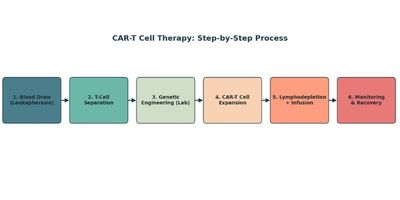
Step 1: Evaluation & Eligibility Screening
Before starting, doctors run blood work, imaging, organ function tests (kidney, liver, heart, lung), and infection screening to confirm the patient can
safely tolerate the therapy.
Step 2: Leukapheresis (Blood/T-Cell Collection)
Blood is drawn through a vein and passed through a machine that separates and collects T-cells, returning the rest of the blood to the body. This
outpatient process usually takes 3–4 hours.
Step 3: Genetic Engineering in the Lab
The collected T-cells are shipped to a specialized lab where a virus is used to insert the CAR gene into the cell’s DNA, reprogramming it to
recognize the target cancer protein.
Step 4: Cell Expansion
The engineered cells are multiplied in the lab over 2–4 weeks until there are enough — often tens to hundreds of millions — to be therapeutically
effective.
Step 5: Lymphodepleting Chemotherapy
A short course of low-dose chemotherapy is given a few days before infusion to reduce existing immune cells, creating space for the new CAR-T
cells to expand and function effectively.
Step 6: CAR-T Cell Infusion
The engineered cells are infused back into the patient through an IV, similar to a blood transfusion. This is usually a single, one-time infusion.
Step 7: Hospital Monitoring
Patients are closely monitored in hospital (often 1–3 weeks) for early signs of side effects such as cytokine release syndrome or neurological
symptoms, since these tend to appear within the first 1–2 weeks.
- Cost of CAR-T Cell Therapy in India
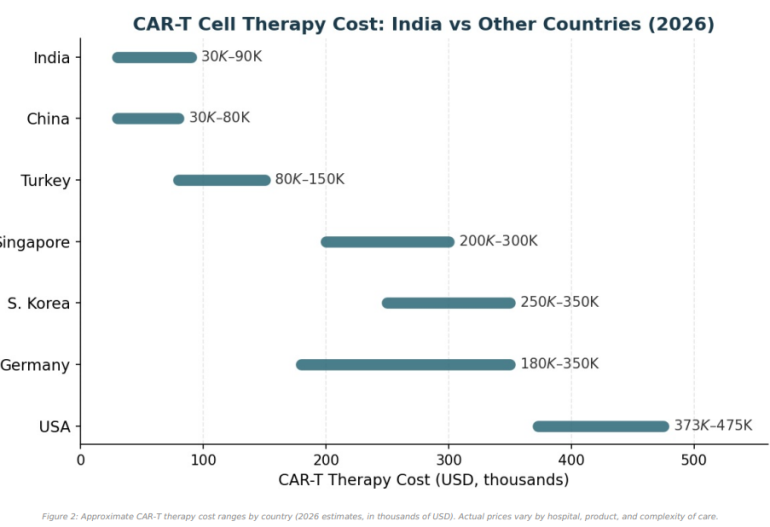
CAR-T therapy costs in India vary widely depending on the product used (imported vs. indigenous), hospital, city, ICU requirements, and
complications during recovery. Based on current data from hospitals and patient-cost aggregators:
| Therapy Type | Approximate Cost |
| Indigenous CAR-T (NexCAR19 / Qartemi) | ₹30–50 lakh (~US$35,000–60,000) |
| Imported CAR-T (Kymriah, Yescarta, Abecma) | ₹60 lakh – ₹1 crore+ (~US$70,000–120,000+) |
| Total cost including hospital stay, tests & follow-up | Add 15–30% to base treatment cost |
For context, the same class of imported CAR-T therapy costs roughly $380,000–$525,000 in the United States — so treatment in India represents
savings of up to 80–90% even before accounting for indigenous options, which push the discount even further.
What Affects the Final Bill?
Product choice: Indigenous products cost significantly less than imported ones.
Hospital & city: Metro-city private hospitals typically charge more than government or Tier-2 city centers.
ICU/room category: Private rooms and extended ICU stays add cost.
Complications: Managing cytokine release syndrome or neurotoxicity can extend hospital stay and cost.
Pre-treatment workup: Consultation, imaging, and lab tests typically add a few lakh rupees.
Note on Insurance: Many government hospitals such as Tata Memorial Centre offer subsidies and help patients access charitable funding. Private
hospitals often provide EMI plans and support with insurance pre-authorization, though coverage for CAR-T is still evolving in India and should be
confirmed directly with your insurer before treatment.
- Who Needs This Therapy (Indications)
CAR-T therapy is generally reserved for patients whose cancer has relapsed after, or did not respond to, standard treatments like chemotherapy or
stem cell transplant. Current approved and commonly treated indications include:
Relapsed or refractory B-cell Acute Lymphoblastic Leukemia (ALL), typically in patients up to 25 years old
Relapsed or refractory Diffuse Large B-Cell Lymphoma (DLBCL) and other aggressive B-cell lymphomas
Relapsed or refractory Multiple Myeloma (BCMA-targeted products)
Certain cases of Chronic Lymphocytic Leukemia (CLL) and Follicular Lymphoma, depending on center and trial availability
Eligibility also depends on overall health, organ function, and absence of active uncontrolled infections, since the treatment temporarily weakens
the immune system. - Risks and Side Effects
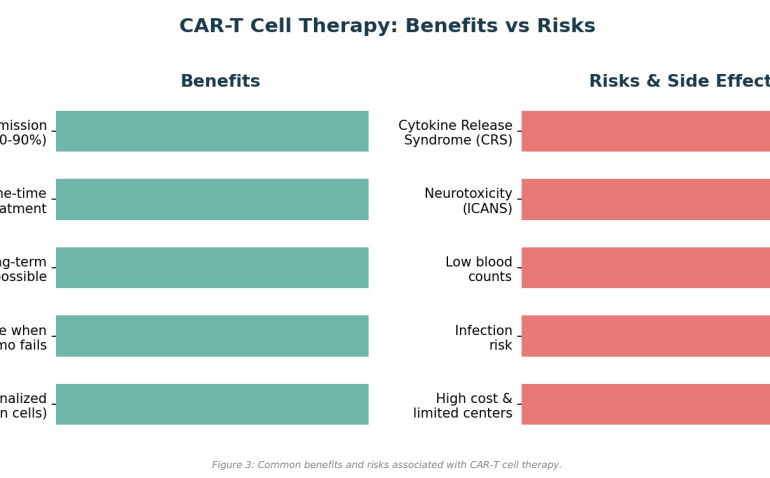
Because CAR-T cells trigger a powerful immune response, side effects can be significant and require close hospital monitoring.
Cytokine Release Syndrome (CRS)
The most common side effect. As CAR-T cells multiply and attack cancer cells, they release large amounts of signaling proteins called cytokines,
causing fever, low blood pressure, and flu-like symptoms. Most cases are mild to moderate and manageable with medication, though severe CRS
can require ICU care.
Neurotoxicity (ICANS)
Some patients develop temporary confusion, difficulty speaking, or in rare severe cases, seizures. This typically resolves with treatment and close
monitoring.
Cytopenias (Low Blood Counts)
Reduced white blood cells, platelets, or red blood cells can persist for weeks, raising infection and bleeding risk.
Infection Risk
A weakened immune system during recovery increases vulnerability to infections, requiring preventive antibiotics/antivirals in many cases.
- Benefits of CAR-T Therapy
High response rates: Many trials report 70–90% overall response rates in patients who had exhausted other options.
One-time treatment: Unlike ongoing chemotherapy cycles, CAR-T is typically a single infusion.
Durable remission potential: Some patients achieve long-term, sustained remission.
Option when other treatments fail: Offers hope for patients who have relapsed after chemotherapy or bone marrow transplant.
Personalized medicine: Uses the patient’s own cells, reducing certain rejection-related risks compared to donor-cell approaches.
8. Top Hospitals Offering CAR-T Therapy in India
Tata Memorial Centre, Mumbai — government-linked center co-developer of NexCAR19
All India Institute of Medical Sciences (AIIMS), Delhi
Apollo Hospitals (multiple cities)
SMS Medical College & Hospital, Jaipur
Other major private cancer centers in Delhi, Mumbai, Chennai, and Hyderabad
Several of these centers are expanding CAR-T infrastructure, with combined annual treatment capacity expected to grow substantially over the
next few years as more indigenous products reach the market.
- Frequently Asked Questions
Q1. Is CAR-T cell therapy a cure for cancer?
It is not guaranteed to be a permanent cure, but for many relapsed/refractory blood cancer patients it produces deep, sometimes long-lasting
remission where other treatments had failed.
Q2. How long does the entire process take?
From initial cell collection to infusion, manufacturing typically takes 2–4 weeks, followed by 1–3 weeks of close hospital monitoring and several
more weeks to months of recovery.
Q3. Is CAR-T therapy available for solid tumors?
Currently approved CAR-T products mainly target blood cancers. Research into solid tumor applications is ongoing but not yet widely available
outside clinical trials.
Q4. Why is CAR-T so much cheaper in India than in the US?
Lower manufacturing, hospital, and labor costs, along with India’s development of indigenous CAR-T products like NexCAR19, have brought prices
down significantly compared to Western markets.
Q5. Does insurance cover CAR-T therapy in India?
Coverage varies by insurer and policy; it is still an evolving area. Many hospitals help patients explore insurance pre-authorization, EMI options, or
charitable funding.
Medical Disclaimer: This article is for general informational purposes only and does not constitute medical advice. CAR-T cell therapy eligibility, risks, and costs vary
by individual case. Please consult a qualified hemato-oncologist and the treating hospital for personalized guidance before making any treatment decisions.
